
Decision Date: 27th February 2023
What happened
Ms X, the mother and Mr Y, her adult son, lived together. In January 2022, Ms X asked the Council to assess Mr Y’s needs. The Council carried out two home visits in February 2022 and another on 28 March 2022. Notes show that the social worker attempted to obtain Mr Y’s views and the goals he wished to achieve, and discussed possibilities of supported living and substance misuse services, to which Mr Y did not want a referral. Notes from the visit in March revealed that the social worker believed that Mr Y was under the influence of drugs at the time of the visit and that he would not accept support for drug use.
The Council sent Mr Y a copy of its care plan on 8 April 2022, concluding that he needed no further support [yes you read that correctly, the Council sent a care plan despite determining that Mr Y was not eligible!]. It also initiated a carer’s assessment for Ms X.
Ms X’s complaint, dated 27 April 2022, said the following about the assessment:
- Its outcome was effectively predetermined because of Mr Y’s substance misuse.
- Its quality deteriorated when looking at Mr Y’s functional domains.
- It said Ms X was implicit in supporting Mr Y to meet people online.
- It had no outcomes [we think this may refer to s.9(4)(b) – the outcomes that the adult wishes to achieve in day-to-day life, but it is not totally clear from the report]
- It ignored the impact on Mr Y’s well-being.
In May 2022, the Council responded to Ms X’s complaint by meeting with her and Mr Y’s advocate [the report is silent on by whom this advocate was appointed, for example the Council], and discussing her concerns with the care assessment. Mr Y did not attend the meeting. Afterwards, the Council amended the care plan, which included adding a section about Mr Y’s well-being and discussing some of the outcomes in more detail. It nonetheless concluded that he did not need any ongoing care and support.
The Council justified that In light of limited engagement from Ms X, they ended her carer’s assessment in August 2022. Records show that the social worker tried contacting Ms X multiple times about the assessment between April and July 2022. The Council met with Ms X and Mr Y at their home on 30 August 2022 to discuss the complaint, providing its final response to them on 14 September. It responded with the following points:
- The assessment explored several potential services, such as voluntary/enrichment services and accommodation. There was no evidence that access to these services was prevented by cannabis use. However, Mr Y indicated he was not willing to engage with such services or consider support to end drug use. Mr Y would not be prevented from using statutory services due to his drug use but the assessment found he was not eligible for these.
- The care assessment dated May 2022 was amended to include more detail in the section regarding functional domains.
- There remained a difference of opinion between Ms X and the social worker regarding how at risk Mr Y was from meeting people online.
- The three Care Act outcomes [again, we think this refers to s.9(4)(b) – the outcomes that the adult wishes to achieve in day-to-day life, although this is not clear because the original complaint contended that the care plan had NO outcomes] which were missing from the original assessment in the amended assessment were addressed.
- A section in the new assessment was included that detailed the impact of Mr Y’s eligible needs on his well-being.
- It was not necessary to provide information about complaints as the Council hoped Mr Y would approach it with any concerns.
The Council agreed to carry out a review of Mr Y’s care needs and carry out a carer’s assessment for Ms X. Ms X was dissatisfied with the Council’s complaint response and complained to the LGSCO. She said that the Council had not completed a review of Mr Y’s care needs or carried out a carer’s assessment. The Council’s justification for not completing a review or carer’s assessment was that it had not done this due to problems with engaging with Mr Y and Ms X.
What was found
The LGSCO’s findings can be divided into two categories: the care assessment and complaint handling.
As to the care assessment, the LGSCO found fault in the care assessment dated April 2022 in two main regards: it did not consider all of the eligible needs which could apply to Mr Y, and did not discuss the impact of such needs on his well-being. The LGSCO also found that in response to Ms X’s complaint, the Council did not actively try to arrange an assessment with Mr Y.
In relation to Ms X’s concerns about the predetermined outcome of the Council’s assessment, the LGSCO did not find any fault. The Council offered Mr Y services related to supporting him with his drug use, but this support was declined. The Council had further explained that some services might be unavailable given that Mr Y had expressed no desire to receive support from them. If he had expressed a desire to receive support from such services, he may have been able to receive support.
The LGSCO found fault in the Council not completing a carer’s assessment for Ms X. Even though there are records of a social worker trying to chase up Ms X about the assessment between April and August 2022, the Council could have carried out the assessment when it was assessing Mr Y’s care needs. There were good opportunities for the Council to carry out the assessment during the several times it visited Ms X and Mr Y at home between February and March 2022, but the fact that it did not do so was a missed opportunity. The consequence of this is that Ms X was unsure about whether she was entitled to any support while caring for Mr Y.
As to the complaint handling, the LGSCO found that the Council could have done better. It should have provided Ms X with a response to her complaint that stated what the Council intended to do, which would have allowed her to continue to progress her complaint to the LGO if she wished. The Council took far too long in responding to her complaint, which it did in September 2022, even though it was initially made in April 2022.
Points to note for councils, professionals, people using services and their carers, advocacy groups, members of the public.
In relation to the care assessment, the report upholds the importance of s9 Needs Assessments including crucial pieces of information that a Council cannot exclude – not surprisingly, given the case law, which the LGSCO has to follow. This includes considering all of the possible eligible needs that can apply to someone being cared for, as well as the impacts these needs may have on their well-being.
If however, a person being cared for uses drugs and does not want any help from services provided by the Council, the Ombudsman’s decision here seems to assume that it will be lawful for the Council to apply a policy of non-provision. We do not agree, but it could easily be explained HOW this is lawful. Muriqi Kujtim is the case that says reasonable conditions can be applied to any offer of services. However, housing is not a social care service and we do not think that Care Act functions can be treated as including nominating a person to a tenancy where a particular provider is the contractor for all who live there, when what is really happening is that the care itself is being refused.
Furthermore, the Guidance makes clear that:
“Prevention and early intervention are placed at the heart of the care and support system, and even if a person has needs that are not eligible at that time, the local authority must consider providing information and advice or other preventative services. Local authorities must also consider the person’s own strengths or if any other support might be available in the community to meet those needs.”
So even if this were to be applied as a reasonable condition, there are opportunities during first contact and the assessment process to sign-post or refer to local drug and alcohol services or charities, who have the appropriate expertise in dealing with these issues (the Council does say in its response that they “explored a number of potential services such as voluntary/enrichment services and accommodation. The Council said there was no evidence access to these services was prevented by cannabis use. However Mr Y indicated he was not willing to engage with these services or consider support to stop drug use”). We think it would be churlish to deny access to services to vulnerable people on the basis of their drug use without at least sign-posting or referring them on to specialised support!
Where there are good opportunities for a council to carry out a necessary carer’s assessment, notwithstanding evidence of a social worker chasing up a carer about the assessment throughout a period of several months, it will be found at fault for not completing a carer’s assessment. It’s as much a duty under s10 as is the duty under s9.
Good opportunities include when a council is simultaneously carrying out an assessment for a person the carer is caring for, such as during home visits. It is imperative that carer’s assessments are carried out when good opportunities for doing so present themselves, otherwise carers will be left unsure about whether they are entitled to any support.
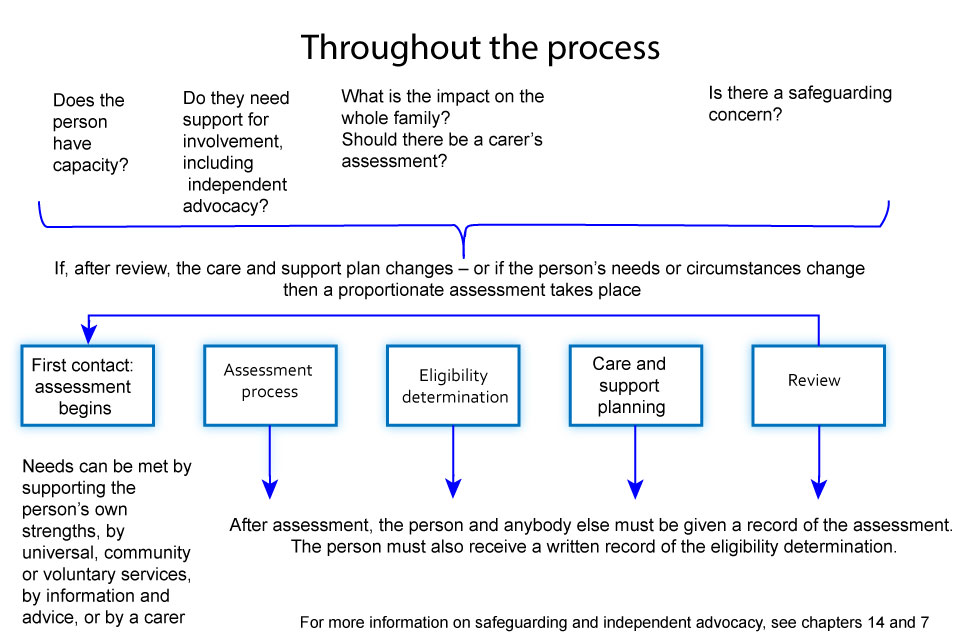
We are gobsmacked by the fact the Council seems to have made an eligibility determination AFTER (or at the same time as?) the care plan! The Guidance is abundantly clear on the process of first contact; assessment; eligibility; care and support planning; and review. This suggests the cart has been put before the horse in Care Act terms, and anyone familiar with adult social care law would probably be wondering why a care plan was completed for someone who wasn’t even eligible! We are equally surprised that the Ombudsman does not draw attention to this most glaring of procedural howlers in their report!
In relation to complaint handling, the report highlights the importance the LGSCO places upon a Council promptly providing responses to complaints. One of the justifications underpinning this importance is the fact that prompt responses allow those complaining to remain informed about a Council’s intended actions, while also allowing them to progress their complaints with the LGSCO if they wish to do so.
Another notable point is that the LGSCO will view it as unacceptable for a Council to respond to a complaint dated June 2022 in September 2022, a time frame of many months. Where this is the case, and it causes a delay in bringing a complaint to the LGSCO, a Council can be asked to pay £100 for the time taken to respond to a complaint and the delay experienced as a result in being unable to bring a complaint to the Ombudsman.
The full Local Government Ombudsman report on the actions of Windsor and Maidenhead Council can be found here: https://www.lgo.org.uk/decisions/adult-care-services/assessment-and-care-plan/22-010-740