
Background and aims of the framework
The guidance intends to provide information on the Department for Health and Social Care (DHSC)’s approach to enhanced monitoring and support, and statutory intervention in adult social care.
There exists a new duty for the Care Quality Commission (CQC) to independently review and assess the performance of local authorities (authorities) in delivering their adult social care functions, as set out under Part 1 of the Care Act 2014 (Care Act).
The CQC is under a duty to inform the Secretary of State for Health and Social Care (the Secretary of State) if it considers an authority is failing to discharge its functions and to recommend any special measures it considers the Secretary of State should take.
Where there are serious and persistent failures, the Department of Health & Social Care will offer ‘enhanced support and monitoring’, asking the authority to produce and implement an improvement plan. Where the authority demonstrates improvement, this support may be withdrawn or tapered off.
If an authority has not been able to tackle sustained problems, the Secretary of State can use new intervention powers introduced through the Health and Care Act 2022, which commenced in April 2023. These powers are likely to be used in the most serious cases.
Intervention powers
Since 1 April 2023, authorities will undergo assessment by CQC on the delivery of functions set out in Part 1 of the Care Act.
Where the Secretary of State is satisfied that an authority is failing or has failed to discharge any of its functions under Part 1 of the 2014 Care Act to an acceptable standard, the Care Act allows it to intervene.
The Secretary of State will consider the nature of the failure, impact and likelihood of it happening again, and will base its intervention on the following:
- A judgement by the Secretary of State of all available information
- Considered engagement with authorities to understand their capacity, capability and commitment to lead their own improvement
It is expected that CQC local authority assessment reports will be the main source of independent evidence for the Secretary of State’s assessment of failure.
- The guidance lists other sources of information, such as publicly published data and documents.
The guidance does not cover other intervention regimes, but the two main ones which may interact with the guidance’s described intervention process are children’s services (DfE) and best value (DLUHC).
The Secretary of State for Health and Social Care will consult with the Secretary of State for Levelling Up, Housing and Communities to assess and further understand any wider context that may impact the local authority.
The process
The guidance includes flowcharts that show an overview of the process for support and intervention.
- Flowchart 1 – Enhanced Support
- Flowchart 2 – Statutory Intervention
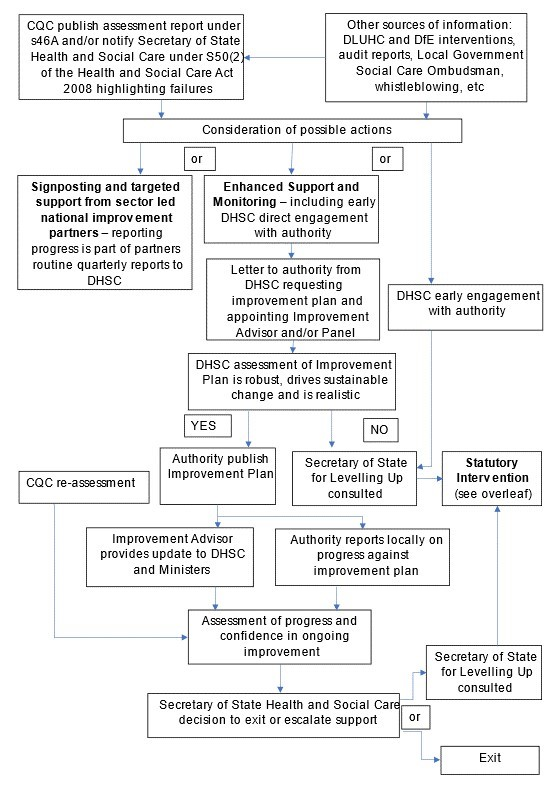

The guidance provides a text alternative to the flowcharts.
The flowcharts give an indication of the likely process but there are likely to be variations reflecting the specific circumstances of each authority that is subject to intervention.
Intervention will generally only occur after a process of dialogue with the authority. Partners may be consulted if appropriate.
Key process points
The guidance sets out several scenarios involving non-statutory intervention:
- Where the Secretary of State for Health and Social Care considers that neither enhanced support nor statutory intervention is appropriate – The Secretary of State expects DHSC will work with improvement delivery partners to signpost authorities to resources and training and/or tailored support available through the national improvement programme to ensure the authority is aware of the range of improvement resources that are available.
- Where the Secretary of State considers the failure is more serious but does not warrant statutory intervention – The Secretary of State envisages asking the authority to work with a non-statutory improvement adviser that we expect to fund and appoint to provide guidance, support and constructive challenge.
- Where an authority has failed to produce a realistic improvement plan or engage with support – The Secretary of State may consider escalating to statutory intervention.
Improvement support
National improvement support
- The Secretary of State for Health and Social Care will support authorities to lead their own improvement wherever possible.
- There are a range of ways in which the DHSC-funded sector-led improvement offer can help authorities. In 2023 to 2024, the support offer includes:
- Regional sector-led improvement
- Partners in Care and Health
- Social Care Institute for Excellence
- Think Local Act Personal
Enhanced support and monitoring
- Where improved data and CQC’s assessment of an authority’s performance highlight failures, the Secretary of State for Health and Social Care may move to an enhanced monitoring and support approach.
- DHSC may appoint an improvement adviser to work with an authority, which DHSC generally funds.
- The improvement adviser will provide support, guidance and challenge to the authority to develop and deliver a robust improvement plan.
Improvement plans and support
- When developing an improvement plan, the authority should liaise with its improvement adviser, where one is appointed, and with DHSC in respect to any additional improvement support required.
- The guidance lists examples of the support areas covered by sector-led improvement partners or other partners delivering the national support offer, including social work practice and safeguarding.
- The guidance lists the features that improvement plans should contain as a minimum, including prioritised actions, outcomes and named individuals.
- Improvement plans should be shared with DHSC and CQC within a set period, which should take no longer than three months. DHSC will review the plan as soon as reasonably possible and consult relevant partners and government departments to ensure there is a co-ordinated approach across national government.
Communication and monitoring
DHSC will publish a notification to the authority setting out the support and monitoring agreed with the authority, and the possibility of statutory escalations should the authority fail to improve in line with an agreed improvement plan.
Authorities are expected to publish their improvement plan and periodically update it to show progress and completion of actions.
Reporting on progress against the improvement plan to DHSC will be proportionate to the issues identified and actions outlined in the improvement plan.
The improvement adviser will be expected to provide regular reports to DHSC outlining the progress made in meeting outcomes and objectives in the improvement plan.
Authority should draw on existing data to inform reporting to DHSC and may be asked to share additional information requested by improvement advisers or DHSC.
Exit and escalation
The Secretary of State will consider whether the enhanced support and monitoring will be lifted or scaled back in the following circumstances:
- The authority has been given a reasonable period to improve and is making clear and evidenced progress against the improvement plan.
The guidance lists examples of evidence to determine whether an authority is able to lead its own improvement, including ongoing CQC assessment reporting.
Where the authority is not able to demonstrate it is on a trajectory of sustainable improvement and there is limited confidence in the authority’s ability to improve, the Secretary of State may consider escalating to statutory intervention.
Statutory intervention
The new powers in the Care Act allow the Secretary of State for Health and Social Care to intervene in an authority where they are satisfied that the authority is failing or has failed to discharge its Care Act functions (under Part 1) to an acceptable standard.
- These powers will generally be used only in the most serious cases and where an authority does not have capacity to lead its own improvement.
Intervention may involve a range of responses from the Secretary of State for Health and Social Care.
Where DHSC funds an improvement adviser, the new powers give the Secretary of State scope to require authorities to meet costs incurred by the Secretary of State in relation to the directions, such as for nominees and related expenses.
Statutory intervention tools
If adult social care statutory intervention is deemed appropriate, the powers enable the Secretary of State to deploy a range of tools that are appropriate to each situation.
The guidance lists examples of what an authority might be directed to do, with an explanation of what this might mean, including the following:
- Act in accordance with advice given by the Secretary of State or a person nominated by the Secretary of State
- Act in accordance with actions in an improvement plan or work with a commissioner to write an improvement plan
- Take specific actions to bring services in line with their 2014 Care Act functions
Practical process
If the Secretary of State is considering statutory intervention, a senior civil servant will send a ‘minded to’ letter to the chief executive and the director of adult social services of the relevant authority. This letter will be published on GOV.UK.
The letter has a ‘main text’ and ‘annex’ section:
- Main text
- Summarises the Secretary of State’s proposals
- Details the reasoning and evidence behind them
- Invites representations from the authority and possibly others
- Annex – This sets out the following:
- The form of the intervention
- How it is proposed to work
- The evidence underpinning it
By this stage, the Secretary of State has only made proposals and these could be changed by representations from the authority in particular and other parties.
The Secretary of State is not required to give authorities an opportunity to make representations where they consider that it is impractical to do so for reasons of urgency.
Directions
Once the Secretary of State has considered the representations received in response to the ‘minded to’ letter, they may decide either not to go ahead with the intervention, or to put in place directions.
Directions (instructions) are the legal mechanism through which the Secretary of State exercises his or her powers under the 2014 Care Act to put in place an intervention.
The guidance lists examples of directions, which may vary significantly, including actions that the authority is required to take and the description of any specified functions to be exercised by the Secretary of State or nominee.
Directions must be set out in writing, and when they are, appointment letters and nominations are also sent out at this point.
Nominees will normally liaise with the authority to agree when they will first arrive.
Nominees
The guidance envisages the use of two types of nominees: commissioners and non-executive commissioners.
- Commissioners – May work on both a non-executive and executive basis
- Non-executive commissioners – May work on a full-time basis within existing authority accountability structures
Appointments will be made following an internal process of drawing up criteria, identifying candidates (often in partnership with the sector on a confidential basis), shortlisting and interviewing.
The guidance lists experiences that will be key for nominees to have, including demonstrable evidence of leading transformational change in the context of growing demand and increasingly constrained resources, while ensuring that the adult social care needs of the population are met.
Formal letters of appointment are only issued when the intervention has been announced and will be copied to the authority. The letters will include details of their appointment, such as fees, arrangements for expenses and expectations.
During an intervention
Interventions can take many forms.
Subject to the scope of directions, commissioners will be largely free to shape their activities themselves according to the needs of the authority subject to the intervention.
Authorities should expect an early dialogue to establish how they will meet the directions and conduct their relationship with the commissioner (where applicable), and agree how they take decisions compliant with the normal expectations for good governance and transparency.
Progress will be recorded through the authority’s own processes for reporting and scrutiny, and there will be an expectation that commissioners will report regularly to the Secretary of State.
- This should be transparent, open to external challenge and available on GOV.UK.
The commissioners will be based at the authority and will generally be supported by DHSC officials.
What is expected of the authority under commissioner-led intervention
The authority under intervention will be directed to provide all resources and support required by a commissioner to carry out their role. The guidance lists what this may include, including allowing full access to all necessary files and records.
Other requirements may be set out in the directions and can vary during the course of the intervention.
Ending or varying an intervention
Where the Secretary of State decides to either revoke or vary the directions, a ‘minded to’ letter will be sent to the authority chief executive and the director of adult social services.
- The letter may set out what functions are to be returned, why and, briefly, the background to the intervention.
- The latter may be copied to key interested parties.
There should be a final meeting between the authority leadership team and ministers, and for DHSC officials to write to the chief executive confirming that no further action will be taken or that directions will be varied.
In considering whether to vary directions, the Secretary of State must consider additional representations from the authority unless the Secretary of State does not consider the variations to be significant.
- The advice of nominated commissioners and/or other key partners such as CQC will be a key source of evidence to support a decision on whether or not to revoke or vary directions.